English
 فارسی
فارسی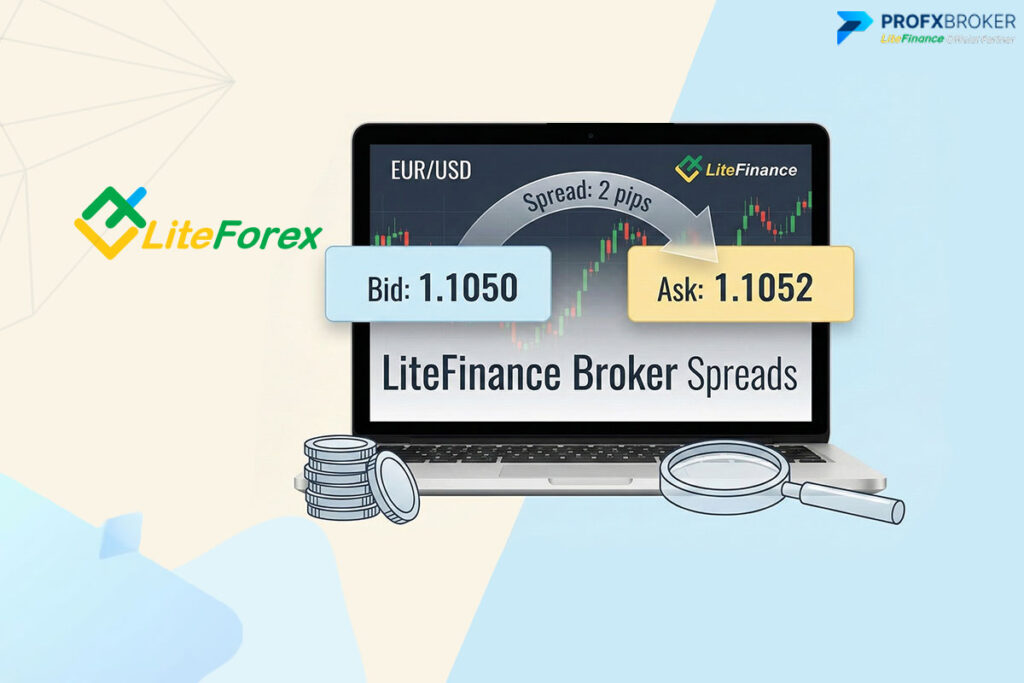
One of the most significant costs in Forex trading that many beginner traders overlook is the Spread. The difference between the buying and selling prices directly impacts your break-even point and final profit.
The LiteFinance spread structure varies entirely depending on the account type, asset class, and trading session. In this article, by closely examining the figures and fees, we will show you which account is more cost-effective for your strategy in terms of spreads.
What is Spread?
Spread is the real-time difference between the Bid (selling) price and the Ask (buying) price. This amount is the cost you pay the broker to open any trade. At LiteFinance, spreads are generally Floating; meaning they decrease as market liquidity increases and expand during periods of high volatility or low volume.
Types of Spreads in LiteFinance
-
Raw Spread: Exclusive to ECN accounts, starting from 0.0 pips.
-
Mark-up Spread: Exclusive to Classic and Cent accounts, which includes the broker’s fee and typically starts from 1.8 pips.
Differences in Spread Levels Across Account Types
LiteFinance spreads vary across different accounts due to the unique characteristics of each account type.
Overview of LiteFinance Account Types:
-
ECN Account: Suitable for scalpers and high-volume traders (Lowest Spread + Commission).
-
Classic Account: Suitable for day and swing traders (Moderate Spread + Zero Commission).
-
CENT Account: Suitable for beginners and robot (EA) testing (Higher Spread + Micro Volumes).
Choosing a trading account must be based on precise cost calculations. The following table provides a technical comparison of LiteFinance account spreads:
| Account Type | Minimum Spread (Starts from) | Spread Type | Commission (Per Lot) |
| ECN | 0.0 Pips | Raw Floating | Yes (Variable from $0.25 and up) |
| Classic | 1.8 Pips | Floating + Mark-up | No ($0) |
| CENT | 3.0 Pips (Average) | Floating | No ($0) |
LiteFinance Fees in the Classic Account
In the LiteFinance Classic account, you do not pay any commission. The broker’s entire revenue is generated through the spread. This structure is ideal for traders who perform long-term (Swing) trades or those who do not want to deal with separate commission calculations. The average EUR/USD spread in this account typically fluctuates between 1.8 and 2.2 pips.
LiteFinance Broker Spread in Prop Accounts
LiteFinance does not offer a specific “Prop Firm” product (like FTMO); however, its Copy Trading system is highly popular. If you operate as a “Prop Trader” or a fund manager within the Copy Trading system, your account spread will be exactly the same as the ECN or Classic accounts, and no additional costs are added to the spread for participating in the Copy Trading section.
LiteFinance ECN Account Spread
The LiteFinance ECN account utilizes NDD (No Dealing Desk) technology. This means you are connected directly to liquidity pools.
-
Average EUR/USD Spread: Between 0.0 and 0.3 pips.
-
Important Note: During “Red News” events (such as the NFP), even in an ECN account, the spread may widen momentarily; however, it returns to normal much faster than in a Classic account.
LiteFinance Broker Spread in the Cent Account
In the LiteFinance CENT account, the primary goal is “education” and “capital management” rather than major profitability. For this reason, the LiteForex Cent account spread is usually higher than other accounts (starting from 3 pips). This extra cost is the price of the service the broker provides for offering extremely low volumes (Nano lots).
Gold Spread in LiteForex
Gold (XAU/USD) is one of the most popular symbols. The Gold spread in LiteFinance is as follows:
-
ECN Account: Raw spread of approximately 15 to 25 points (1.5 to 2.5 pips) + commission.
-
Classic Account: A more stable but higher spread, usually around 40 to 50 points (4 to 5 pips). If you are a Gold scalper, the ECN account is undoubtedly the more logical choice.
Differences in LiteFinance Spreads Across Various Sessions
Market liquidity changes at different times of the day, which directly impacts the spread:
LiteFinance Spread in the New York Session
During this session (04:30 PM to 12:30 AM Iran time), spreads reach their absolute minimum due to the high volume of Dollar trades. The best time for scalping with the lowest cost is the London and New York overlap.
LiteForex (LiteFinance) Spread in the London Session
The London session (10:30 AM to 07:30 PM) is the heartbeat of the market. Spreads for European currency pairs like EUR/USD and GBP/USD are very tight and competitive during this window.
LiteFinance Spread in the Tokyo Session
In the Asian session (03:30 AM to 12:30 PM), liquidity for the Dollar and Euro decreases. Consequently, the spread for these pairs may increase. However, the spread for Yen-based pairs (like USD/JPY) is favorable during this session.
LiteForex Zero Spread Account
LiteFinance does not have a completely “Zero Spread” account (Fixed Zero), but its ECN account is effectively spread-free (0.0 pips) during many hours of the day. Note that the “Islamic” (Swap-Free) account has no impact on the spread and only removes overnight interest.
Comparing LiteFinance Fees with Other Brokers
Technically, LiteForex spreads and commissions in the ECN account are highly competitive and on par with top-tier global brokers. However, in the Classic account (starting from 1.8 pips), spreads are slightly higher than the industry average (which is usually 1.2 to 1.5). Therefore, the strength of LiteFinance lies in its ECN accounts.
Spreads for Various Trading Assets
Currency Pair Spreads in LiteFinance
-
Majors (EUR/USD, GBP/USD): Very low (ECN: 0.1 pips).
-
Crosses (GBP/JPY, EUR/CAD): Moderate (ECN: 1 to 2 pips).
-
Exotics (USD/TRY): Very high and volatile.
Commodity Spreads in LiteFinance
Oil (WTI and Brent) usually has a spread of about 3 to 5 pips, which is suitable for day trading.
Index Spreads in LiteFinance
Indices generally have more stable spreads compared to currencies.
-
Dow Jones Spread in LiteFinance: The Dow Jones index (YM) in LiteFinance is usually offered with a spread of about 1.2 to 2 points, which is very attractive for speculating on this index.
Metals Spreads in LiteFinance
In addition to Gold, the Silver (XAG/USD) spread is also competitive in the ECN account; however, due to the different pip value, you must be careful with your money management.
Forex Stock Spreads in LiteForex
The spread for stocks (such as Apple or Tesla) is variable and only has suitable liquidity and tradability during US Stock Market hours (New York session).
Conclusion
To reduce your trading costs in LiteFinance, the final formula is: If your strategy is short-term and your trade frequency is high, definitely use the ECN account during the New York and London sessions. The Classic account is only economically justified for trades with large price targets (TP), where a few extra pips of spread do not significantly affect the outcome.