English
 فارسی
فارسی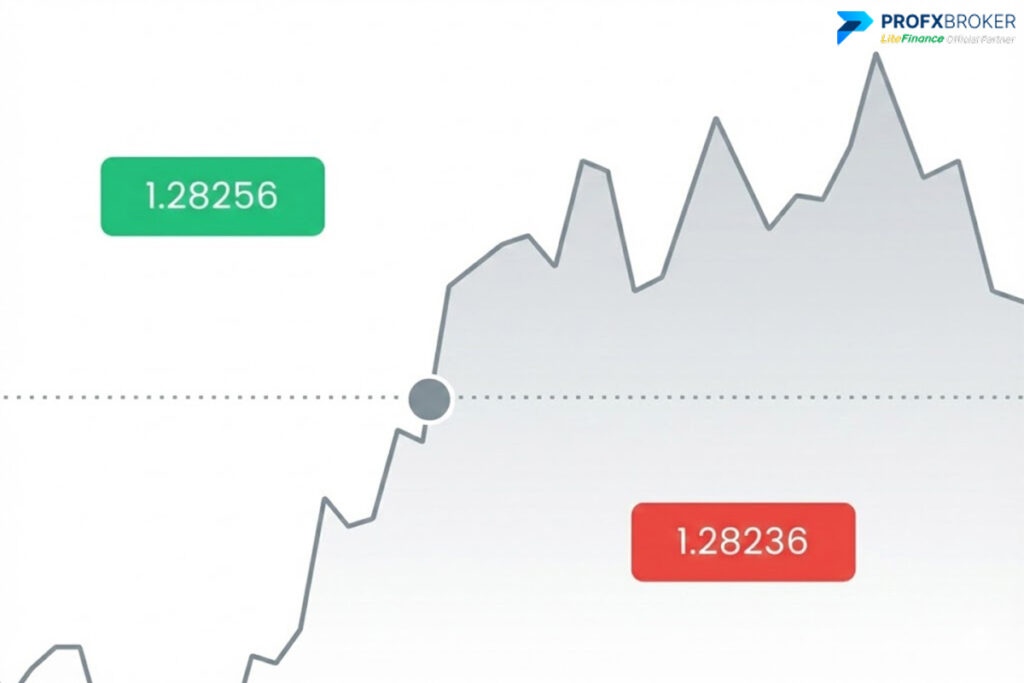
Have you ever wondered why the moment you press the Buy or Sell button in MetaTrader, your trade immediately starts with a negative number (a loss)? This initial loss isn’t a software bug or bad luck; it is your cost of entering the market, known as the Spread.
Understanding the exact mechanics of spread is crucial for a trader. Failing to recognize how spreads fluctuate—especially during news releases—is one of the primary reasons for premature Stop Loss triggers and unforeseen losses. In this article, we examine the technical structure of Bid and Ask, how to calculate costs precisely, and the reasons behind spread widening.
What is Spread in Forex?
In financial markets, Spread refers to the difference between the buying price (Ask) and the selling price (Bid) of an asset at a specific moment. It serves as the primary commission collected by the broker for connecting the trader to the global market.
In simpler terms, the spread is the price gap between what the market is willing to pay to buy from you and what it is willing to charge to sell to you. This price gap is the broker’s source of income. To better understand how brokers operate, visit our “What is a Broker” article.
The Concept of Bid and Ask and Their Role in Spread
To deeply understand spread in the Forex market, you must recognize that there are two different prices for every currency pair at any given time:
-
Ask Price: The price at which you Buy (always higher).
-
Bid Price: The price at which you Sell (always lower).
The ironclad rule of the market is this: you always buy a currency slightly higher than the real price and sell it slightly lower.
Technical Tip for MetaTrader: By default, charts only display the Bid line. To avoid visual errors, you should enable the “Show Ask Line” option in the MetaTrader settings (Properties) to see the actual spread distance on your chart.
How to Calculate Spread in Forex
Calculating spread does not require a complex formula. Simply subtract the Bid price from the Ask price.
Formula:
Real-World Example:
Suppose the prices for the EUR/USD pair are as follows:
-
Ask Price: 1.1005
-
Bid Price: 1.1003
The difference is 0.0002. Since the fourth decimal place in most currency pairs is known as a Pip (one of the essential Forex terms), your spread here is equal to 2 Pips. This means the market must move 2 pips in your favor just for you to reach the break-even point (zero).
Types of Trading Spreads: Floating or Fixed?
Brokers offer two spread models based on their liquidity provision. Choosing between them has a direct impact on your strategy.
1. Floating Spread
What is a floating spread? In this model, the spread amount is not constant and changes based on market supply and demand. Most professional accounts (ECN) use this model.
-
Advantage: During high-volume periods (like the London session), the spread is very low and cost-effective.
-
Disadvantage: During news events or extreme volatility, the spread can increase significantly.
2. Fixed Spread
In this model, the broker guarantees that the spread will always be a specific amount (e.g., 3 pips), regardless of market conditions.
-
Advantage: Cost calculation is easy, and you don’t have to worry about spread widening.
-
Disadvantage: The constant rate is usually higher than the average floating spread, and there is a possibility of “Requotes.”
Technical Comparison Table:
Would you like me to translate the Technical Comparison Table for you? Just send the code or the content of the table.
| Feature | Floating Spread | Fixed Spread |
| Trading Cost | Usually lower (Variable) | Usually higher (Fixed) |
| Order Execution | No Requotes (Market Execution) | Possibility of Requotes (Instant Execution) |
| Suitable For | Scalpers and Day Traders | Specific EAs (Robots) and News Traders |
What is Spread Widening and Why is it Dangerous?
Spread widening refers to a situation where the gap between the buying and selling prices increases suddenly and significantly. This phenomenon usually occurs in two scenarios:
-
During Major News Releases: (e.g., NFP or Interest Rate decisions) where banks push prices further apart to manage their risk.
-
During Rollover: Between 12:00 AM and 01:00 AM (broker server time), when New York banks have closed and Tokyo banks have not yet fully opened, causing liquidity to hit its minimum.
The Major Risk: You might have a Sell position where the chart price (Bid) hasn’t reached your stop loss yet. However, due to spread widening, the buying price (Ask) jumps up and hits your stop. The Result: Your trade is closed at a loss even though the candles visually never touched your stop loss level.
What Factors Influence Spread Levels?
As a trader, you must know when to enter the market to pay the lowest costs. Three main factors affect Forex spreads:
-
Liquidity: The more buyers and sellers there are in the market, the lower the spread. This is why the EUR/USD spread is always lower than that of an exotic currency like the Turkish Lira (USD/TRY).
-
Volatility: When the market is calm, the spread decreases. During emotional or high-volatility periods, liquidity providers increase the spread.
-
Trading Sessions: The lowest spreads occur during the London and New York session overlap. The highest spreads occur at the start of the Sydney session (early morning Iran time). To learn more, visit our article on “Forex Sessions in Iran Time.”
Hidden Spreads and Zero Spread Accounts
Is there such a thing as a free trade? No. Some brokers offer accounts labeled “Zero Spread” or “ECN,” where the raw market spread (near 0.0 pips) is passed to the trader. However, be aware that in these accounts, the broker earns its revenue through a Commission.
So, how is the Alpari or LiteFinance spread calculated? In their ECN accounts, you don’t pay a spread, but you pay a fixed amount (e.g., $3 to $5) in commission per lot traded.
Summary of “What is Spread”:
Spread is an unavoidable business cost in trading. Understanding how to calculate it and knowing when it widens is the line between a professional and an amateur trader.
Final Recommendations:
-
If you are a Scalper, always use floating spread (ECN) accounts.
-
Avoid trading during the daily rollover (around 12:30 AM Iran time), as spreads become highly irrational.
-
Always factor in the current spread when setting your Stop Loss so you don’t get stopped out by “spread spikes.”