English
 فارسی
فارسی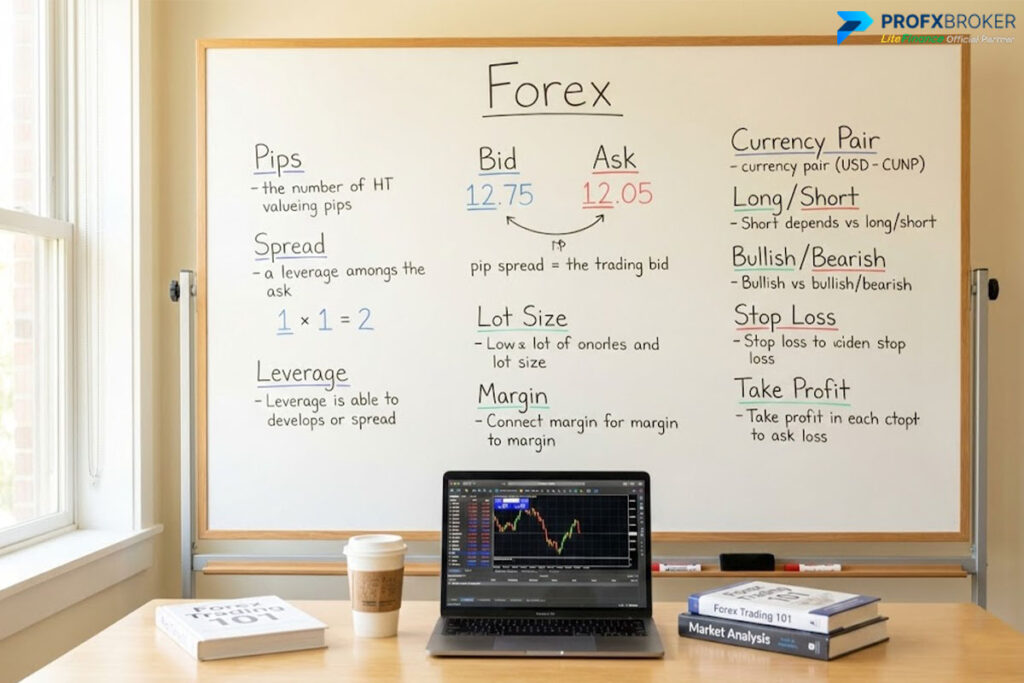
Entering the world of trading without knowing Forex terminology is like traveling to a foreign country without knowing its language; you might be able to walk around, but you will definitely get lost. Many beginners feel confused when they hear words like “Pip,” “Leverage,” or “Spread.” Don’t worry—this is the common language of the market, and learning it is the first step toward becoming a successful trader. In this article, we examine the most important Forex trading terms, categorized for practical use.
What is Forex Terminology? (Basic Concepts)
Forex market terms are a set of specialized, global standard words that traders use to describe price, volume, trade types, and market status. Learning these concepts is vital for operating platforms like MetaTrader and understanding technical analysis.
Below, you will find Forex terminology training in three main categories (Price Concepts, Volume Concepts, and Execution Concepts):
1. Currency Pair
In Forex, you trade one currency against another. The first currency listed is the “Base” currency, and the second is the “Quote” currency. If you are unfamiliar with this topic, it may be helpful to refer to the “What is Forex” article.
-
Example: In the EUR/USD pair, the Euro is the base currency and the Dollar is the quote currency. When you buy this pair, it means you are buying Euros and selling Dollars.
2. Pip
Pip stands for “Percentage in Point” and is the smallest standard unit of price change in most currency pairs, usually calculated at the fourth decimal place. Your profit and loss in Forex are calculated based on the number of pips the price has moved.
-
Note: In currency pairs involving the Japanese Yen (e.g., USD/JPY), a pip is the second decimal place.
3. Spread
Spread is the difference between the buying price (Ask) and the selling price (Bid) of a currency pair at any given moment. This amount is effectively the commission that the broker deducts from you the moment you open a trade.
-
Example: If the Ask price is 1.2005 and the Bid price is 1.2002, your spread is 3 pips.
Terminology Related to Capital and Volume
To manage your capital, you must be familiar with common Forex terms regarding money and volume:
4. Leverage
Leverage is the credit provided by a broker that allows you to open larger volume trades with small Forex capital. Leverage is like a double-edged sword; just as it can multiply your profit tenfold, it can also multiply your loss tenfold and destroy your account.
-
Example: With 1:100 leverage and $100 in capital, your buying power becomes $10,000.
5. Margin
Margin is the amount of money blocked in your account as “collateral” to open a position. When the position is closed, this amount is released. Margin has an inverse relationship with leverage; the higher the leverage, the less margin you require.
6. Lot
Lot is the unit of measurement for trade volume in Forex. A standard lot is equal to 100,000 units of the base currency. For smaller capitals, mini-lots (0.1) and micro-lots (0.01) are used.
-
Formula: A volume of 0.01 lots in the EUR/USD pair means that every pip of fluctuation results in approximately 10 cents of profit or loss.
Terminology for Trading Orders (Order Types)
In the process of becoming familiar with Forex terms, trading orders play a vital role in executing a strategy:
7. Long and Short Positions
-
Long Position (Buy): When you predict the price will go up, you enter a buy trade.
-
Short Position (Sell): When you predict the price will go down, you enter a sell trade.
8. Stop Loss (SL)
Stop Loss is an order where you specify that if the price moves against your prediction, the trade will automatically close at a certain point to prevent the destruction of your entire capital.
9. Take Profit (TP)
Take Profit is an order where you specify that once the price reaches your target, the trade will automatically close and your profit will be secured.
10. Swap
Swap, or overnight interest, is an amount applied if your trade remains open for more than one business day. A swap can be positive (deposited into your account) or negative (deducted from your account), depending on the interest rates of those countries’ currencies.
Forex Terms in Technical Analysis
To understand charts, remember these Forex terms in simple language:
Candlestick:
A type of price representation that shows the opening, closing, high, and low prices within a specific time frame.
Trend:
The overall direction of market movement (Bullish/Upward, Bearish/Downward, or Ranging).
Range:
A market condition where there is no clear direction and the price fluctuates between two levels.
Download Forex Terminology PDF
Many users look for a Forex terminology PDF file to have constant access to it. We have prepared all these definitions along with 50 other specialized terms (including types of indicators and patterns) in a comprehensive file.
Final Word
Learning Forex terminology does not happen overnight. We suggest you bookmark this page and return here whenever you encounter a word in analyses or news that you don’t understand. Remember, knowing the definitions is not enough; you must practice their application in a Demo account.